
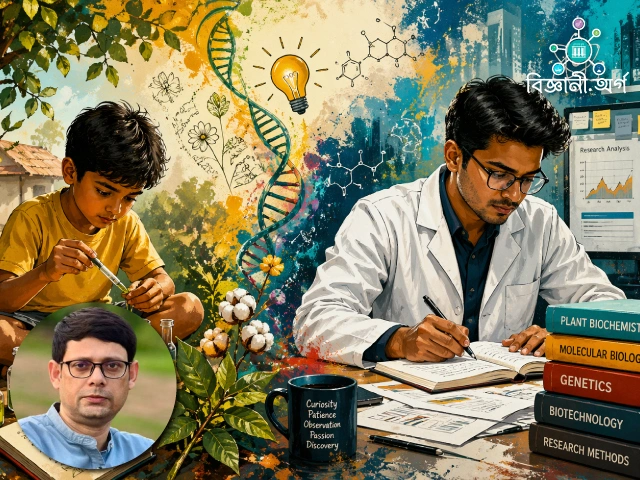
To many, the proverb “Morning Shows the Day” may be mere rhetoric; to me it is the echo of a deep truth of life. Today I no longer stand at the laboratory bench running experiments each day; instead I seek science’s answers through the pages of research papers, the depths of theory, and the rigorous analysis of international journals. Looking back from here, I feel again and again that this journey did not begin today, but long ago — on those quiet, solitary afternoons of childhood.
As a child I did not know what “biochemistry” meant, nor the meaning of any scientific term. Yet a strange curiosity drew me toward nature’s smallest changes. The leaves of trees, the colours of flowers, the mixing of unknown saps and latexes — all of these were a mysterious world to me. In a corner of the courtyard or beneath a tree I would set up my own little laboratory. Into a broken pot I would pour the white latex of the gulancha vine, into another the milky sap of the akanda plant, and sometimes the green juice of telakucha leaves — and I would wait with unblinking eyes for the longed-for change to happen.
In reality, nothing happened. No smoke rose; no colour changed. Yet within that waiting there was a strange joy, a deep attentiveness. Today I understand that the child was not running a failed experiment; he was learning patience, learning observation, learning to trust the unseen. Those silent afternoons of nature had, in fact, sown within me the seed of a researcher — one who later stood in the laboratory and who today, seated at the writing desk, still enters the depths of science.
Another important memory of my childhood is entwined with a cotton plant. Standing beside the window of my room, that plant was a silent companion; its branches swayed in the wind as if calling me. My little sister, my friends and I would pick cotton from it, and with that cotton we made tiny pillows and quilts for our dolls. The soft touch of that cotton was an inseparable part of our world of imagination.
Who could have known that the very same cotton would one day become the focal point of one of the greatest scientific inquiries of my life? Many years later, deeply engaged in my academic journey, the same plant — cotton — returned. Now it is no longer merely a plaything of childhood; it is a complex scientific entity within which lie hidden tolerance, adaptation, and a profound story of survival. When I read or analyse writing about cotton in a research paper, I feel as if I am speaking with that old plant once more — only now the language is different.
This connection makes me think again and again. Between that childhood play and this present academic pursuit, is there some invisible bridge? Or is it merely a wondrous coincidence of time? Slowly I have realised that a person does not become something all at once. Our inner interests, our curiosity, our world of thought — the seeds of all these are sown long before, when we have not yet even learned to understand them. This, it seems, is nature’s riddle.
Today, when I analyse the complex theory of a research paper, weigh the strengths and weaknesses of a manuscript, or try to give shape to a new idea in words, I remember that little child — who sat silently mixing the juices of various leaves, waiting for a miracle. Then I understand that science is not confined within the walls of the laboratory; it is a long journey — an endless path moving from curiosity to knowledge, from play to analysis, and from feeling to wisdom.
This story is not mine alone; it is the story of all those who have never lost the curiosity of their childhood. For nature begins to show us the way long before — only, as we grow up, we forget that language. And those who can hold on to that language, their very lives become an exquisite tale.
Gallery
Originally published by the author on Biggani.org. You can also read it at https://biggani.org.