
1. Introduction: Earth’s Most Ancient Biological System
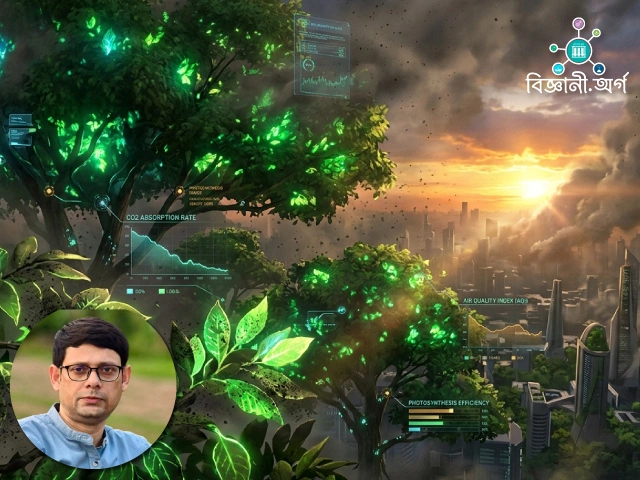
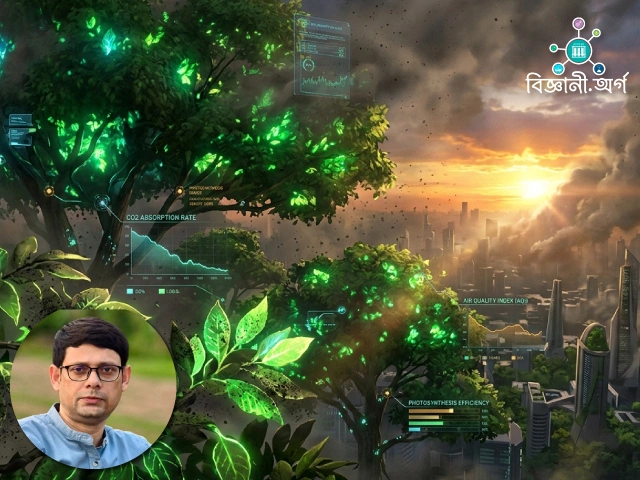
As the light of dawn slowly pierces the planet’s hazy sky and descends, an invisible war begins — silent, yet ceaseless. There is no sound, no explosion, and yet the outcome of this war will determine our future. Who are its soldiers? They are the leaves of trees.
Every leaf is like a tiny bio-factory in which the work of capturing carbon runs without pause. The sum of billions of leaves forms the planet’s largest natural “carbon capture system” — one older, more precise and more sustainable than any industrial technology. But the grey smoke of the modern city has created a new crisis for these green soldiers: an invisible enemy that suffocates them and slowly renders them lifeless.
2. The Hidden Science of the Canopy: The Language of LAI (Leaf Area Index)
How efficiently a tree absorbs carbon depends on the structure and arrangement of its leaves. An important index for measuring this capacity is the Leaf Area Index. Put simply, LAI measures the total leaf area over a given area of land. The more leaves, the more sunlight captured, the more photosynthesis, and the more carbon absorbed.
But a subtle truth is hidden here: increasing the number of leaves is not enough — the leaves must also be effective. Inside every leaf are tiny pores, the stomata, through which the tree takes in carbon dioxide. So the higher the LAI, the greater the total stomatal surface area can be, and therein lies the potential for carbon absorption.
3. The Urban Paradox: When the Oxygen-Giver Itself Struggles to Breathe
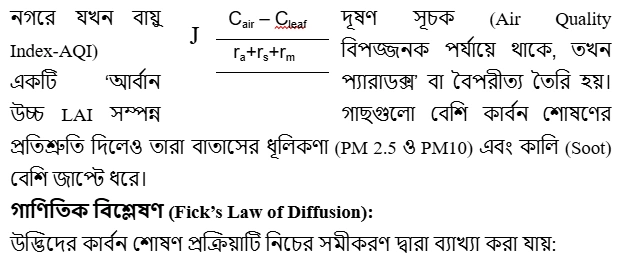
When a city’s Air Quality Index (AQI) reaches dangerous levels, an “urban paradox” arises. Although high-LAI trees promise greater carbon absorption, they also trap more airborne dust (PM2.5 and PM10) and soot.
Mathematical analysis (Fick’s Law of Diffusion). The carbon-absorption process can be described by:
J = (Cair − Cleaf) / (ra + rs + rm)
where Cair = CO₂ concentration in air, Cleaf = CO₂ concentration inside the leaf, ra = boundary-layer resistance, rs = stomatal resistance, and rm = mesophyll resistance. When dust physically clogs the stomata, rs rises many times over and the carbon flux J falls exponentially. Despite its vast array of leaves, the tree becomes unable to absorb carbon: the greater these three resistances, the lower the leaf’s rate of carbon absorption.
4. Species Selection: Bridging LAI and APTI
In urban planning, large leaves alone are not enough; a tree must also tolerate pollution — its APTI (Air Pollution Tolerance Index). Some species that lead this fight:
- Banyan and Peepal (Ficus benghalensis / religiosa): very high LAI and high APTI make them unrivalled at absorbing carbon and dust in industrial zones; their vast canopies act as urban carbon sinks.
- Neem (Azadirachta indica): although its leaves are small, high stomatal density and chemical make-up give it strong pollution tolerance, and its chlorophyll content stays stable even in high-AQI areas.
- Chatim (Alstonia scholaris) and Kadam (Anthocephalus cadamba): their leaf arrangement ensures maximum light capture (high LAI), helping keep photosynthesis running under heavy pollution.
5. The Energy Balance and the Revolutionary Role of AI
A leaf’s carbon-absorption capacity depends on its energy balance, described by the Leaf Energy Balance Equation:
Rn = H + λE + G + S
where Rn = net radiation, H = sensible heat flux, λE = latent heat flux (transpirational cooling), G = conduction, and S = metabolic/photosynthetic storage. When dust shuts down transpiration, λE falls and leaf temperature can rise 8–10 °C above its surroundings. In this state Rubisco, the key enzyme of photosynthesis, loses efficiency — so the tree is not only suffocated but also breaks down under heat stress.
This is where Artificial Intelligence opens a new horizon:
- Precision monitoring: computer vision can calculate how thick the dust layer on a leaf has become and how much rs has risen as a result.
- Predictive analytics: machine-learning models on AQI and weather data can flag which tree urgently needs “canopy hygiene” — a cleaning of its leaves.
- Digital twin and simulation: turning a city’s afforestation into a virtual model lets AI simulate how much carbon a species will remove from the atmosphere over the next 20 years.
6. Policy Recommendations
1. Correct species selection. Make it mandatory to plant high-APTI trees such as banyan, neem and chatim in industrial areas.
APTI = [A(T + P) + R] / 10
where A = ascorbic-acid content, T = total chlorophyll, P = leaf-extract pH, and R = relative water content. Based on APTI, trees fall into three categories:
| APTI value | Tolerance level | Use |
|---|---|---|
| 1–16 | Highly sensitive | Used as bio-indicators (they die and signal when pollution rises) |
| 17–29 | Intermediate | Generally planted in urban areas |
| 30–100 | Highly tolerant | Ideal for green belts in industrial areas and along roads |
2. Canopy management. In the dry season, wash the leaves of important city trees; making leaves dust-free effectively doubles their carbon-absorption rate.
3. AI-driven carbon dashboard. Establish a central data centre to monitor tree health and carbon-absorption rates in real time.
7. Conclusion: Tomorrow’s Technology for Environmental Balance
The afforestation and carbon control of the future are no longer limited to traditional tree planting. Only when the rigorous research of the laboratory is joined with the mathematical precision of AI can we build an invincible scientific defence against climate change. Just as leaves take energy from sunlight and give life, we too must take the right technological decisions from the light of data. Remember: if leaves become hidden beneath a shroud of pollution, the paralysis of the planet’s lungs is only a matter of time.
Gallery
Originally published by the author on Biggani.org. You can also read it at https://biggani.org.